
Belem, Brazil – November 21, 2025
 Tens of thousands of delegates from nearly 200 countries traveled to Belem, Brazil for the COP 30 UN Climate Change Conference in the Amazon, and the world was left wanting. Across every major global issue – climate, oceans, refugees, biodiversity, etc. – our systems of global governance fall short on delivering what is needed. While many have lost hope, or plan for an escape to Mars, some creative thinkers have recently joined forces to develop what may become a viable solution to our current geopolitical stalemate and looming ecological dystopia.
To begin, it is key to understand that the UN system is not a platform for binding world law. The Paris Climate Agreement, for example, is aspirational rather than enforceable. If a country fails to meet its climate objectives, it merely faces an international shrug. Some popular proposals have been developed for reform of the multilateral system that could fix these shortcomings in global commons governance, such as the idea of a Second Assembly in the UN to unite the voice of global civil society with voting powers equal to those of nation-states. Unfortunately, this, and every other major UN reform proposal to date, has been vetoed by one of the 5 permanent members of the UN Security Council. Some countries just don’t want to let go of power, even when to do so would benefit us all. As a result, transnational issues are chronically under-governed, and there is now risk of large-scale damage to the environment and the global commons.
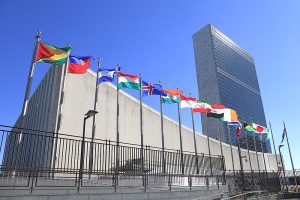 The global commons are essential. They are the natural resource domains that lie outside the political reach of any one nation-state and are considered shared resources for all of humanity. How can regular people come together and develop a solution to legally recognize the global commons and manage it responsibly? How can we break the nation-state monopoly on global commons governance and bring the choice of planetary sustainability to everyone? How can we do it in a way that is incremental, non-adversarial, and systemic?
Consumer adoption of “global commons compliant” bank accounts may be the answer. Today, each time you swipe a credit card, there is an underlying risk analysis and variable transaction fee. Industries with high risk of credit card fraud, usually pay higher fees. If consumers demand it, banks will issue new credit cards, and other financial products, with transaction fees that are calibrated to consider other kinds of risk, such as damage to the global commons. Financial services with such embedded fees could be “global commons certified.”
This fee variability could serve as a mechanism of checks and balances for a new system of global commons policy development and enforcement. Instead of transaction fees set only by nation-states, they could be set by a global “Second Assembly” convened by indigenous communities and global civil society, separate from the UN system, but in collaboration with it. Carefully targeted increases and decreases in transaction fees could incentivize responsible corporate behavior. The revenue generated could pay for nature restoration and other needs of the global commons.
The proposal is incremental because each new user of the system would permanently help to strengthen it. The idea is non-adversarial because it doesn’t take power away from any one side, but instead creates new power for the global commons, and for all of us. Finally, the idea is systemic because it fosters the development of a new platform for governance that can impact many transnational issues, bypass the shortcomings of our current multilateral system, and adjudicate issues that until now have been ungovernable.
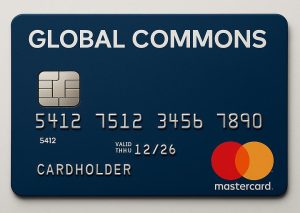 The idea is audacious, but also simple and powerful. It merits a conversation. Anyone can understand it, and intuit its viability. A marketing campaign for it could honestly advertise, “This credit card could save the world.” Consumer choices that favor socially responsible products have been a core principle with which the social justice campaigns of yesterday created the international norms we see today. New banking today could serve as the vehicle for consumers to demand responsible management of the global commons tomorrow.
How would this system work? Who would be involved?
Around the world, banks follow national laws, the policies of the Basel Committee of the Bank of International Settlements, and other directives. Nothing prevents a bank from updating its charter to follow the transaction fee directives of a new body, such as the “Second Assembly” envisioned above, or a “Global Commons Commission” or a “Global Commons Fund.”
Many moving parts for this proposal are already in motion.
In June, 2025, the Global Commons Fund (GCF) was announced to the world with the publication of the White Paper on the Global Commons and Philanthropy. A group of 20+ experts on international policy and global affairs put their minds together to educate the philanthropic sector about the history and possible future of multilateralism, its many shortcomings to date, and the potential for further innovation. They addressed many global issues ranging from AI safety and nuclear non-proliferation, to climate governance and refugee resettlement. They also announced the first Global Commons bank cards from Redemption Bank, with transaction fees supporting diverse causes via the GCF.
 While the GCF and Redemption Bank are actively working to educate consumers and implement the ideas outlined in this article, they also partnered with the Amazon (Rainforest) Investor Coalition (AIC) to actively support global commons stewardship. The Amazon forest, a central pump of the global water cycle, is on the precipice of collapse, and securing its ecological integrity is an urgent global priority. The GCF and AIC have launched a call to action for the Amazon to demonstrate how this new global commons governance system can urgently address pressing transnational issues.
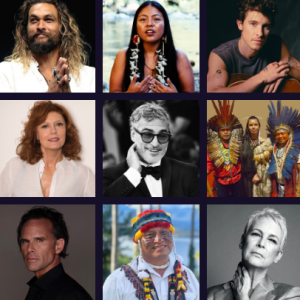
 As a first step, the AIC mobilized $10 million in philanthropic support for the Amazon, as part of the GCF strategy. As a convergence point of global philanthropy, the GCF unites experts and grantmakers to inform the flow of donations to global commons issues. To reach the masses, in August, 2025, the AIC joined the world’s biggest Youtuber, MrBeast, to launch the TeamWater campaign, with the announcement video now seen over 85 million times. The GCF then explored collaboration with the fintech startup MrBeast Financial, and through the AIC co-launched Amazonia Calling to promote indigenous demands for COP30. It grew to become one of the largest celebrity coalitions in history, involving names such as Jason Momoa, Jamie Lee Curtis, Shawn Mendes, Alok, and hundreds of others.
 Capitalizing on these celebrity, philanthropy, and fintech advances to promote the Amazon and global commons stewardship, the Global Commons Commission (GCC) was created in August, 2025, to facilitate a political process for global commons governance. Scale will be key. Though $10 million in philanthropy for the Amazon is an important step, one academic analysis suggests that we will need between $1.7 and $2.8 billion/year to preserve the Brazilian region of the forest, a number that is $1 billion greater than the philanthropy/foreign aid budgets seen in the Amazon today.
To scale, the GCC is convening core constituencies that will be central to building the vision of a “Second Assembly” inside (or outside) the UN, including Indigenous People, the Private Sector, Civil Society, Science/Academia, and Governments. Each will play a decisive role. For the GCF and GCC to achieve real global commons governance, for Amazon forest conservation, or any transnational issue, important questions will need to be answered, obstacles will need to be overcome, and millions of people will need to get involved.
How could legal recognition of the global commons work in practice? How much funding could be mobilized from transaction fees through a GCF/GCC mechanism? Will GCF/GCC transaction fees be passed on to consumers? Why are religious communities and NGOs with large membership associations from around the world excited to take part? Why is the private sector joining in? How does signing up for a new bank account represent participation in and support for a new political system? How can new technologies be used to facilitate mass participation and improve upon the political and global governance systems of the 20th century, in order to match the needs of the 21st? Will federal governments perceive the GCF/GCC as a challenge to their hegemony?
There are clear answers backed by significant scholarship for each of these questions.
- Legal Theories: Five different legal theories lay out the pathway for global commons recognition, ranging from fiduciary responsibility to global administrative law.
- Funding Levels: One estimate suggests that GCF/GCC oriented transaction fees on credit cards could generate more than $65 billion a year from the US market alone, without disrupting business as usual. Even a tiny fraction of that could save the Amazon.
- Cost to Consumers: While some transaction fees may be passed on to consumers, they would be imperceptible to most (less than 0.5% of transaction value), with some fees calibrated to convey true-cost pricing in some sectors.
- Mass Adoption: Religious organizations and NGOs with membership bodies are looking for new ways to raise revenue. By joining the GCC Call to Action and promoting adoption of global commons compliant banking services and brands, they can benefit financially through member agreements with the GCF/GCC in ways that lower customer acquisition costs for participating banks.
- Private Sector Leadership: Many of the largest global players in the private sector are alarmed about future business failures and revenue losses related to biodiversity collapse, climate change and desertification. The finance sector is facing mounting pressure to consider the global commons and comply with the mandates of the Task Forces on Climate and Nature Related Financial Disclosures. One report argues that certification by the GCC represents a systemic solution that could reduce the costs of compliance with these new accounting systems. In fact, some forward thinking companies are privately working on RFPs to announce that they will soon only do business with global-commons-compliant financial services.
- Political Support: Upon signing up for a global commons compliant bank account, users will receive email invitations to participate in online referendums and other participatory global governance processes. Users will be able to lend their voices directly or delegate their representation to others. If a user signs up through a member NGO, it will lend credibility and legitimacy to that organization, while strengthening the representative power of the convening process and the agency of the users and consumers who participate. An October, 2025, study about global governance legitimacy and participation outlines possible strategies for collective agreement, action and technological solutions.
- New Governance Systems: The UN system was created in 1945 to solve the international problems envisioned at that time, such as preventing World War III. New technologies like the Internet, AI and mobile phones today make possible new kinds of mass participation and consensus building that were unavailable 80 years ago. With innovations like liquid democracy, citizen assemblies and blockchain, these systems can also be made immune to fraud, foul play, co-optation by special interests, and other maladies that plague our current political systems.
- Challenging Hegemony: As the GCC and GCF become important vectors of national and multilateral influence, they may face opposition from autocrats and nationalists who oppose global cooperation. However, such attention will further drive adoption given that wide majorities of citizens prefer international cooperation on most issues, and wide majorities of consumers endorse small price increases to address climate. Ironically, the ability of the GCC/GCF idea to contain US-led destruction of the international order may be the very thing that makes it popular with consumers.
To get involved in promoting responsible management of the global commons, and support the development of the systems that seek to bring such hopes into reality, we invite you to peruse the websites of the Global Commons Fund and the Global Commons Commission, or write to contact@globalcommonsfund.org